Network Overview
Injective (INJ) is a high-performance Layer-1 blockchain designed specifically for finance. Unlike general-purpose blockchains, Injective was built around the premise that financial applications require specialized infrastructure for trading, liquidity, interoperability, and settlement.
Founded in 2018, Injective initially focused on creating decentralized derivatives and exchange infrastructure. The network has since expanded into a broader financial blockchain supporting spot and derivatives markets, lending, real-world assets, stablecoins, automated trading, and other financial applications.
Injective differentiates itself through a combination of native financial infrastructure, fast finality, low transaction costs, interoperability, and a suite of plug-and-play modules designed for developers building financial applications.
The network’s core value proposition centers on three attributes: finance-specific infrastructure, interoperability, and efficient on-chain markets. Injective’s architecture includes a native orderbook and exchange module, decentralized oracle infrastructure, native interoperability with Ethereum, Solana and IBC-enabled networks, and support for multiple virtual machine environments. These components allow developers to build financial applications without having to recreate core market infrastructure from scratch.
Founders, Goals and Network Architecture
Eric Chen is the co-founder and CEO of Injective. Chen studied computer science and finance at NYU and worked on trading strategy and protocol research, including at Innovating Capital, before leaving school to build Injective.
Albert Chon is the co-founder and CTO of Injective. Chon has played a central role in the technical development of the network, including its Cosmos-based architecture, consensus infrastructure, and financial modules. Injective’s founders began experimenting with Ethereum before turning toward the Cosmos ecosystem, where they became early contributors to the broader interchain ecosystem.
Injective was also part of the first cohort of the Binance Labs (now YZI Labs) incubation program and subsequently attracted backing from investors including Jump Crypto, Pantera Capital and Mark Cuban.
Injective was initially created to address structural limitations in decentralized exchanges, particularly high transaction costs, front-running, fragmented liquidity, slow execution, and poor user experience. The team’s original vision was to create a decentralized trading infrastructure that could offer the functionality of centralized exchanges while maintaining blockchain-based settlement and user-controlled assets.
Over time, that vision expanded from a decentralized derivatives exchange into a broader financial Layer-1. Today, Injective’s ecosystem encompasses decentralized exchanges, perpetual futures, lending, trading infrastructure, automated vaults, tokenized assets, stablecoins, and other financial applications.
Injective takes a different approach from general-purpose Layer-1 networks. Rather than providing a neutral blockchain on which financial applications must construct their own infrastructure, Injective incorporates financial functionality directly into the base layer. This includes native components for; spot and derivatives trading, on-chain orderbooks, oracle infrastructure, auctions, trading execution, cross-chain asset transfers, stablecoin infrastructure, real-world assets, and staking and governance. This specialization is intended to allow developers to build financial applications with less infrastructure overhead while maintaining composability between applications.
Network Consensus
Injective uses a Proof-of-Stake (PoS) consensus mechanism based on a customized implementation of CometBFT (formerly Tendermint) Byzantine Fault Tolerant consensus engine. Validators participate in block production and network security by staking INJ, while token holders can delegate their INJ to validators.
The consensus architecture provides near instant finality and relatively short block times. Injective currently reports block times of approximately 620 milliseconds and low transaction costs.* The PoS process on Injective generally follows three steps; INJ holders stake or delegate tokens to validators, validators participate in consensus and block production, and validators and delegators receive staking rewards for securing the network. Staked INJ can also participate in governance decisions affecting network parameters, upgrades, and other protocol functions.
Proof-of-Stake (PoS) offers several benefits, including fast transaction finality, low transaction costs, greater energy efficiency than Proof-of-Work, economic security through staked capital, native governance, and interoperability with IBC-enabled networks. Injective’s consensus architecture is particularly well suited to financial applications, where execution speed and predictable settlement are critical.
Like other PoS networks, Injective’s security depends on the economic incentives and decentralization of its validator set. The active validator set on Injective is capped at 45 validators and was at that cap as of October 2026. Concentration of token ownership or delegated stake can result in greater influence among larger stakeholders.
INJ Token Overview
INJ is the native asset of the Injective blockchain and serves several functions within the network. The token is used for; transaction fees, staking, network security, governance, trading-related applications, collateral, ecosystem incentives, and protocol value capture.
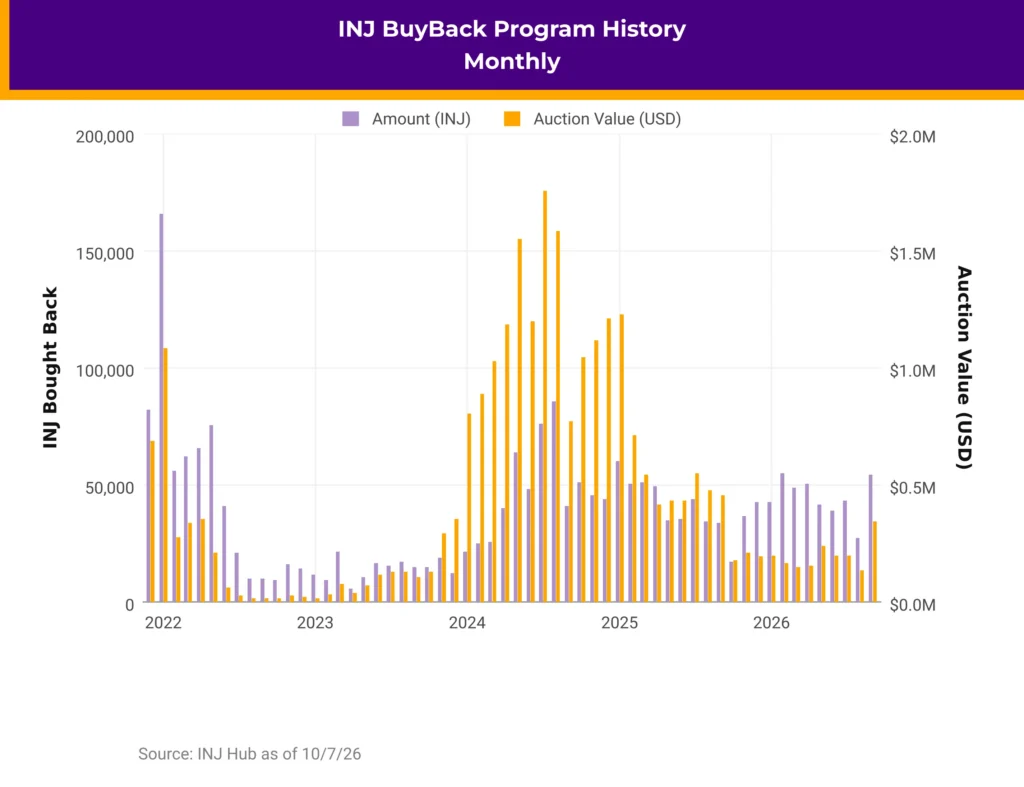
Injective’s token economics are designed so that network activity can contribute to reductions in supply through its buyback-and-burn mechanisms, offsetting new INJ issued as staking rewards. As of October 2026, total INJ supply reported on-chain was approximately 122.9 million, approximately 22.9% above the 100 million issued at the token generation event, reflecting that cumulative issuance since inception has exceeded cumulative burns. The Injective tokenomics framework describes INJ as the native asset securing the network, facilitating transactions, participating in governance, and serving as a medium of exchange throughout the ecosystem.
INJ has undergone several tokenomics upgrades since the launch of the network. The original token economics incorporated a weekly burn auction in which a portion of exchange fees was used to purchase and permanently burn INJ.
- In 2023, INJ 2.0 expanded the burn mechanism so that applications beyond exchange protocols could contribute revenue to the burn mechanism.
- In 2024, INJ 3.0 further modified monetary policy, increasing the responsiveness of the supply mechanism to staking activity and accelerating the potential rate of supply reduction.
- In 2025, Injective transitioned from the original winner-take-all burn auction toward a Community BuyBack model. Participants commit INJ in exchange for a pro-rata share of ecosystem revenue, while the committed INJ is permanently burned.
- In 2026, the INJ Supply Squeeze further tightened the protocol’s issuance parameters. The Injective Foundation has stated that the proposal permanently increases the rate of supply reduction by 100%. The annualized issuance bounds in effect were a 2.20% floor and a 4.40% ceiling, against a Goal Bonded Percentage of 60%.
- As of October 2026, more than 7 million INJ had been permanently burned cumulatively through the Burn Auction and its successor, the Community BuyBack.
The current Injective model therefore creates a relationship between ecosystem activity and token supply: increased revenue can result in increased INJ purchased and permanently removed from circulation.
INJ’s utility is closely connected to the operation of the Injective network.
- Staking: INJ is used to secure the network through Proof-of-Stake. Token holders can delegate INJ to validators and receive staking rewards.
- Governance: INJ holders can participate in governance decisions affecting network parameters, upgrades, and financial infrastructure.
- Transaction Fees: network transactions are denominated in INJ, creating a direct connection between blockchain activity and token utility.
- Financial Applications: INJ can be used as collateral and within various applications throughout the Injective ecosystem.
- Value Capture: One of the more distinctive elements of INJ’s token design is its connection to network revenue.
Revenue generated by applications using Injective’s financial infrastructure contributes to the Community BuyBack, where committed INJ is permanently burned.
Fees generated by applications using Injective’s financial infrastructure can contribute to the Community BuyBack mechanism, where INJ is subsequently burned.
Injective operates as an independent Layer-1 blockchain built specifically for financial applications. Its architecture combines native financial modules, a multi-VM environment running over shared state, CometBFT consensus with instant finality, and native interoperability. Rather than requiring developers to build financial infrastructure independently, Injective provides several components directly at the protocol level.
One of Injective’s primary differentiators is its native financial infrastructure. The network includes modules for; spot trading, derivatives, orderbooks, auctions, oracle feeds, token issuance, staking, and governance.
The native exchange module allows applications to use on-chain orderbook infrastructure, including order management, matching, execution, and settlement. This architecture allows multiple applications to interact with shared liquidity and financial infrastructure rather than operating as completely isolated protocols.
Originally built within the Cosmos ecosystem, Injective uses Inter-Blockchain Communication (IBC) to connect with other networks. Its interoperability strategy has since expanded to include Ethereum, with native SPL token support on Solana going live on September 17 and plans to extend connectivity across additional blockchain ecosystems. This approach is particularly relevant for financial applications, where liquidity and collateral are often distributed across multiple networks. Injective aims to serve not as an isolated financial chain, but as infrastructure connecting liquidity and financial applications across blockchain ecosystems.
Injective further expanded its development environment with native Ethereum Virtual Machine (EVM) support on mainnet beginning November 11, 2025. This enables Ethereum-compatible applications and developers to build directly on Injective, broadening its developer base beyond Cosmos and allowing existing Ethereum applications and tooling to leverage its financial infrastructure. Injective’s MultiVM architecture supports native modules, EVM, and WebAssembly (WASM) within a shared state, allowing developers across these environments to access the same underlying financial infrastructure.
Financial Applications
Injective’s ecosystem has evolved from a derivatives-focused network into a broader financial application platform. Applications built around Injective include; decentralized exchanges, perpetual futures, spot markets, lending, automated trading, yield strategies, liquid staking, real-world assets (RWA), and tokenized financial products. The network’s financial specialization is intended to allow developers to construct increasingly complex applications from shared infrastructure.
Real-World Assets
One of Injective’s key development priorities since 2023 has been bringing real-world assets (RWAs) and traditional financial activity on-chain. Its iAssets framework is designed to make tokenized assets programmable and composable, allowing them to interact with decentralized financial applications for lending, hedging, and yield generation. Combined with infrastructure for compliant asset issuance and cross-chain connectivity, this approach positions Injective at the intersection of decentralized finance (DeFi) and traditional capital markets. Recent initiatives and partnerships illustrate the breadth of Injective’s RWA ecosystem, spanning mortgage records, trade finance, compliant issuance, institutional investment products, stablecoin settlement, and on-chain trading. Key developments include:
- Mortgage records: Pineapple Financial has moved more than $1 billion in residential mortgage records on-chain, creating verifiable digital records of underlying loans.
- Trade finance: POSCO International and LG CNS selected Injective for a pilot to tokenize and settle trade receivables generated through international commerce.
- Compliant issuance: Injective Mint, introduced in July 2026, enables issuers to create and manage assets with configurable holder restrictions, jurisdictional controls, and issuance and redemption permissions.
- Institutional investment funds: Through Libre, Injective supports on-chain access to tokenized funds associated with BlackRock, Hamilton Lane, and Nomura’s Laser Digital, including money market, private credit, and market-neutral investment strategies. These products offer potential on-chain utility such as secondary trading and collateralized lending, subject to applicable restrictions.
- Regulated securities infrastructure: On August 19, 2026, Injective Institutional Services became an SEC-registered transfer agent, adding infrastructure for maintaining official securities ownership records and processing transfers.
- Stablecoin settlement: Injective partnered with BDACS in October 2026 to explore KRW1, a Korean won-backed stablecoin, as a settlement asset for tokenized markets. Injective also supports native USDC issued by Circle.
- On-chain RWA trading: Injective has expanded beyond asset issuance into trading and derivatives linked to real-world and institutional assets, including tokenized fund products and pre-IPO market exposure. This creates potential connections between tokenized assets and broader on-chain financial activity.
Taken together, these developments illustrate Injective’s broader strategy of combining tokenization, institutional-grade controls, settlement infrastructure, and on-chain markets. Rather than simply representing traditional assets as tokens, the objective is to make them usable within a connected financial ecosystem.
The Regulatory Landscape
As digital assets have grown in size and adoption, regulators have increased scrutiny of blockchain networks, exchanges, custodians, token issuers, and decentralized financial applications. For Injective, the regulatory environment is particularly relevant given the network’s focus on financial markets, derivatives, trading, and tokenized assets.
Regulatory developments in 2026 have included the launch of the first U.S. regulated INJ futures on CFTC-regulated exchange Bitnomial on April 15, Injective’s publication of a Markets in Crypto-Assets (MiCA) whitepaper and inclusion in ESMA’s interim MiCA register on July 16, and Injective Institutional Services’ registration with the United States Securities and Exchange Commission
(SEC) as a transfer agent on August 19. These developments reflect progress toward integrating Injective-related services and products with established regulatory frameworks.
Greater clarity around digital asset market structure and tokenized financial products could support the development of decentralized financial infrastructure. At the same time, requirements governing trading platforms, derivatives, stablecoins, securities, and tokenized assets may introduce additional compliance obligations for applications operating on Injective.
Network Activity
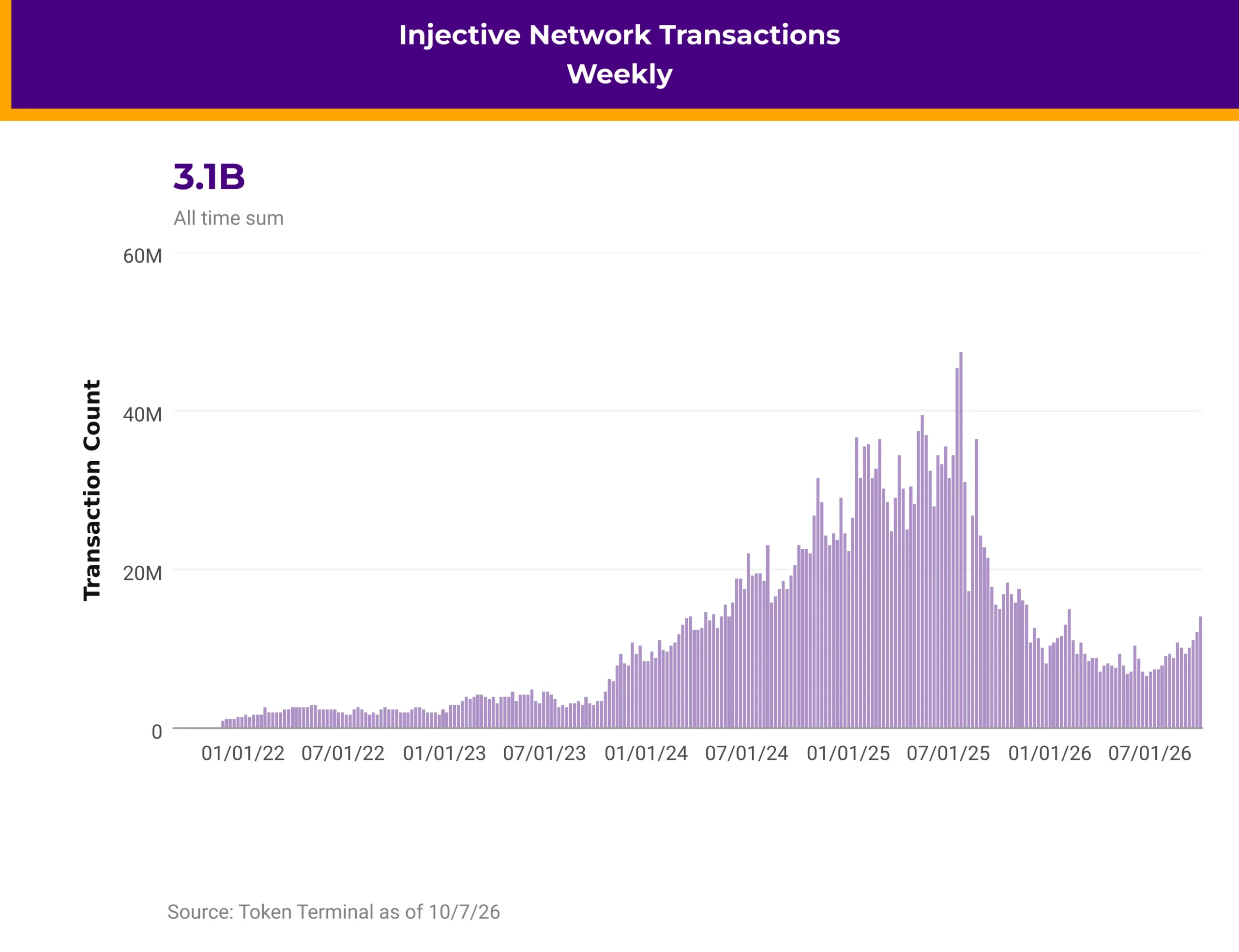
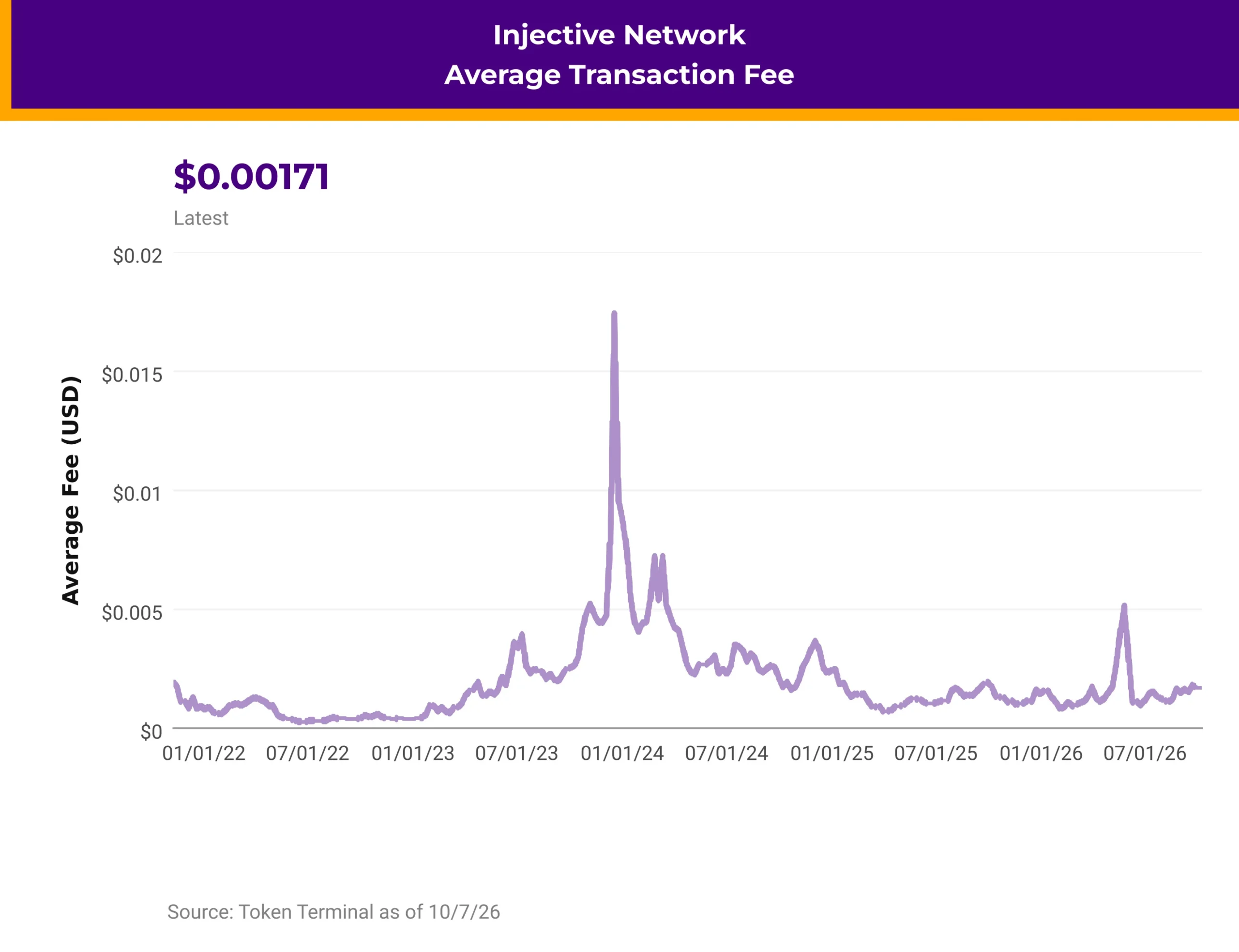
Injective has developed into a highly utilized blockchain network, with transaction activity reaching tens of millions of transactions per day during periods of peak usage. The network’s low transaction costs support high-frequency activity across trading, DeFi, and other on-chain applications, while its dual Cosmos and EVM architecture allows activity to occur across both execution environments. This combination of high throughput and low costs has positioned Injective as a blockchain purpose-built for financial applications and increasingly active on-chain markets.
Over the past several years, transaction activity on Injective has increased substantially, reaching a peak of nearly 50 million daily transactions in mid-2025 before moderating and recently beginning to accelerate again. At the same time, the average transaction fee has remained extremely low, currently around $0.0017 per transaction. The combination of rising transaction activity and consistently low fees highlights Injective’s ability to support significant on-chain usage without materially increasing the cost of transacting.
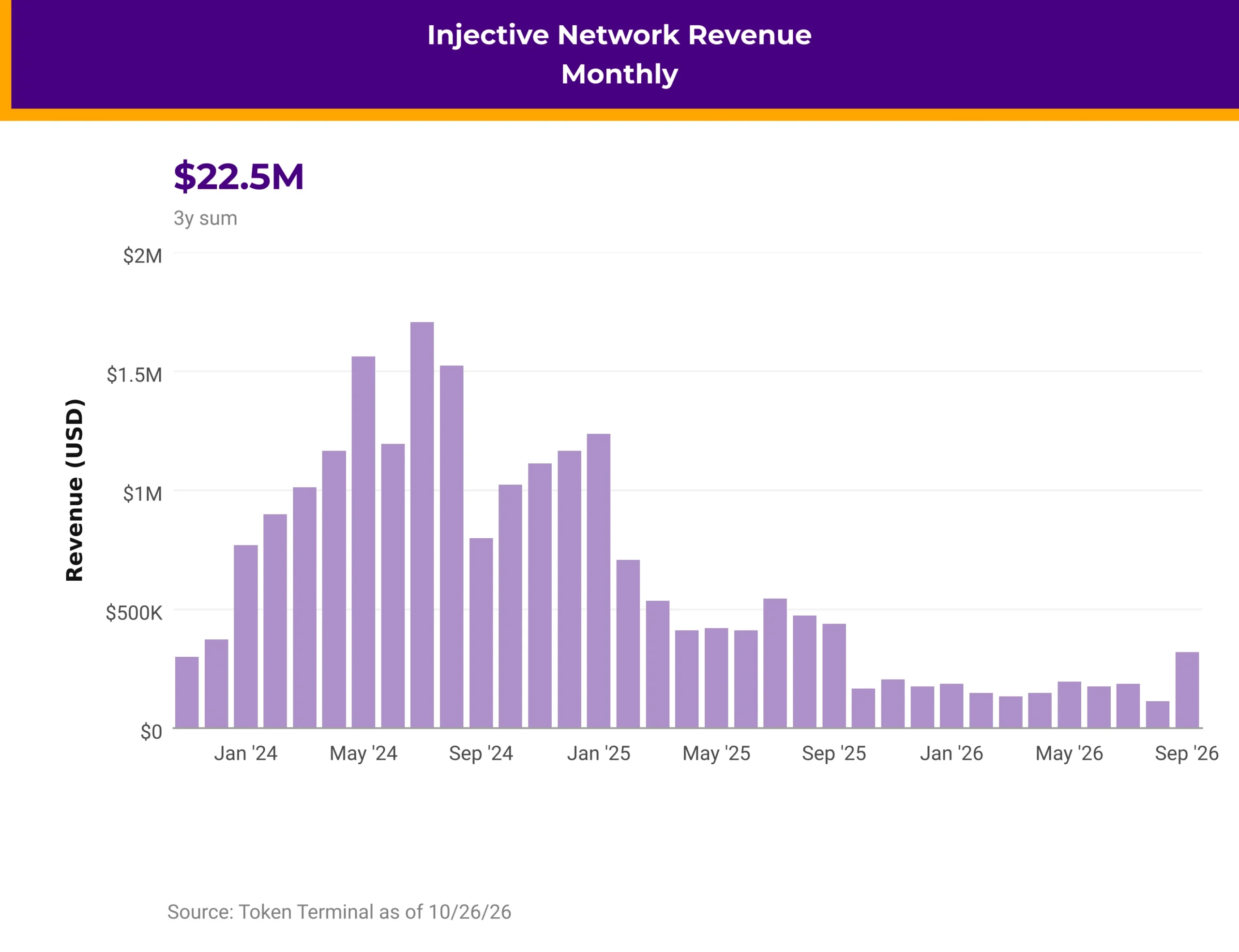
Revenue generated across Injective’s ecosystem provides insight into economic activity and demand for its financial applications. Revenue may include trading fees, transaction fees, and other fees collected by applications on the network. Sustained revenue growth can indicate expanding adoption and increased activity, while declining revenue may signal weaker demand or reduced application usage.
Revenue is also relevant to INJ token economics, as Injective uses eligible application revenue to fund INJ buybacks and burns. However, revenue should be assessed alongside user activity, trading volumes, and token supply dynamics, since growth in revenue does not necessarily translate into proportional value accrual for INJ holders.
According to Token Terminal, Injective has ranked among the top 10 blockchains by cumulative revenue over the past three years.
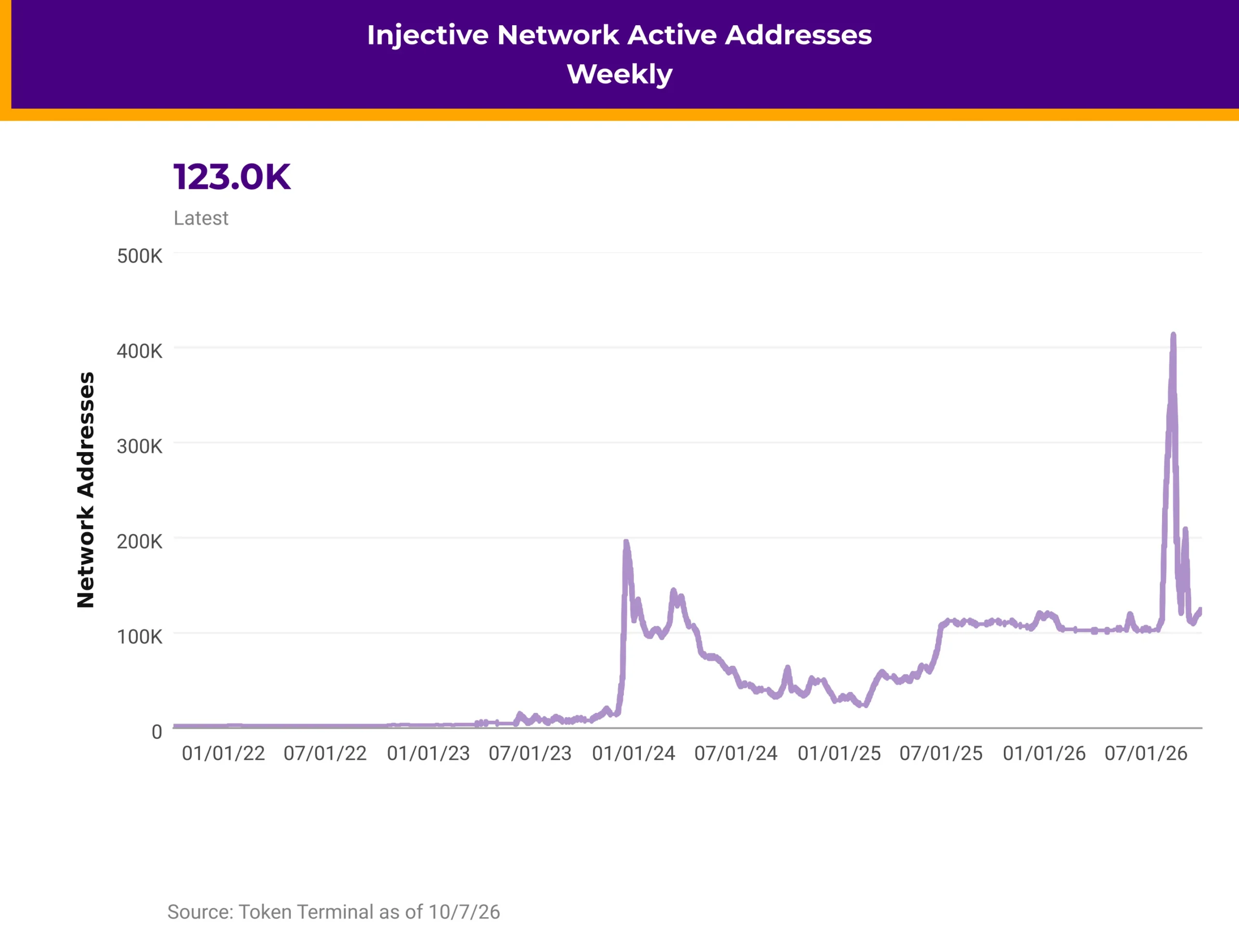
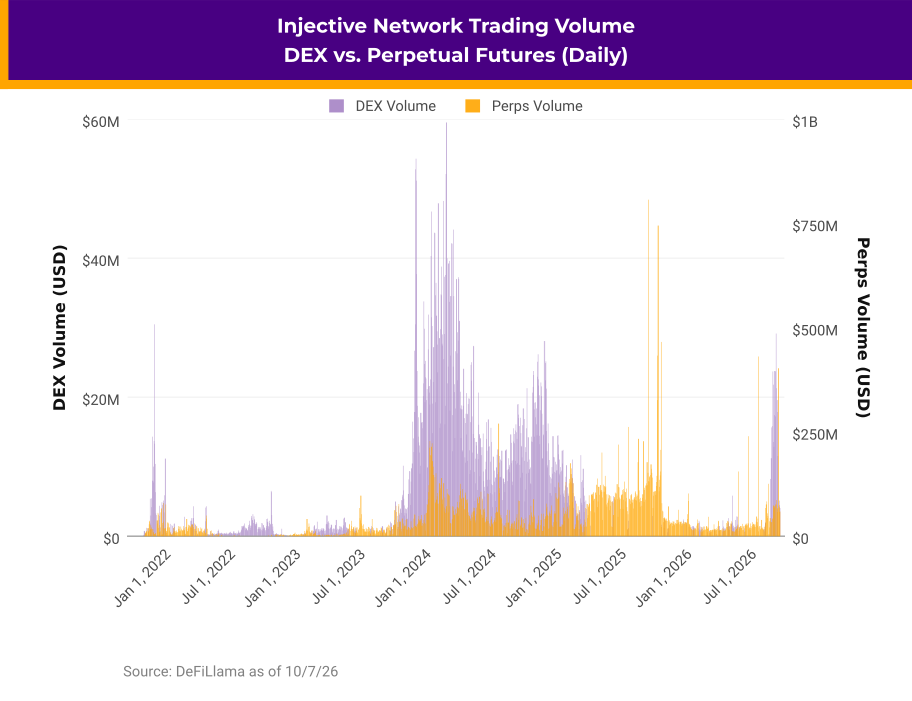
For Injective, trading volume, active users, transaction activity, and application-level usage provide complementary measures of network adoption. On-chain activity saw a significant increase in mid-to-late 2026, driven primarily by EVM adoption and expanding real-world asset (RWA) trading, with institutional and tokenization initiatives providing an additional catalyst.
Active and unique addresses provide a measure of network participation and can be used to assess whether blockchain usage is expanding. Injective has historically experienced substantial growth in addresses and transaction activity as its ecosystem expanded. As with other blockchains, however, address counts should be interpreted carefully because one individual or application can control multiple addresses, while automated activity can also contribute to transaction counts.
The institutional push accelerated in August, as Injective expanded its focus on bringing real-world assets, including tokenized equities and financial products, on-chain. A key milestone came on August 19, when Injective Institutional Services became an SEC-registered transfer agent, enabling regulated securities recordkeeping and supporting tokenized asset issuance through Injective Mint. This development strengthened Injective’s institutional infrastructure and its position in on-chain capital markets.
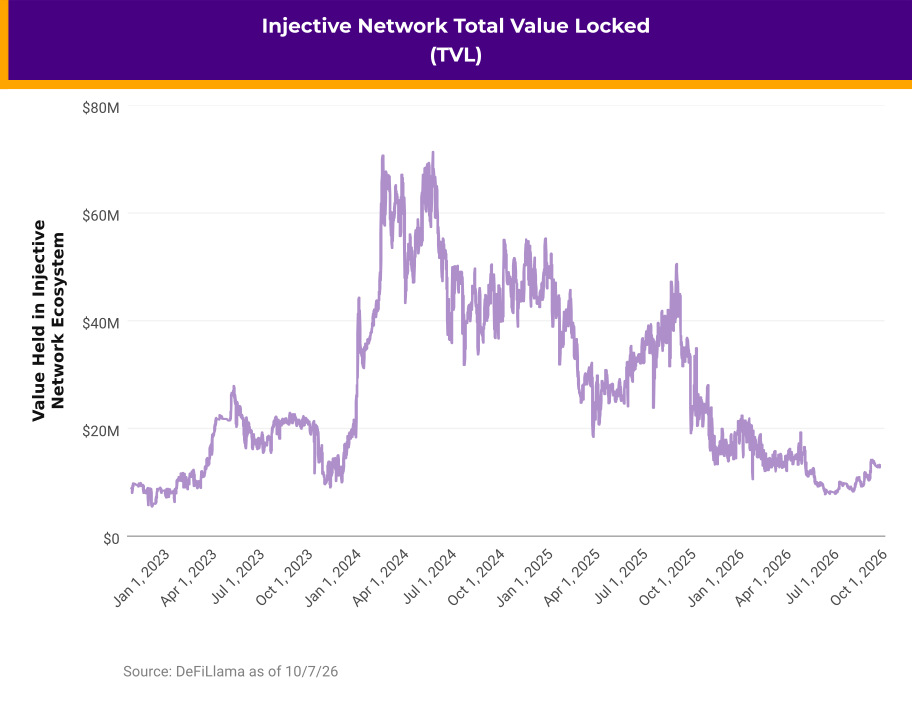
Total Value Locked (TVL) measures the value of cryptocurrency assets deposited in decentralized finance (DeFi) protocols. It is commonly used to assess a network’s scale, liquidity, and adoption, although changes in TVL can reflect both shifts in user activity and fluctuations in underlying asset prices. Injective’s TVL remains relatively modest compared with larger Layer-1 networks.
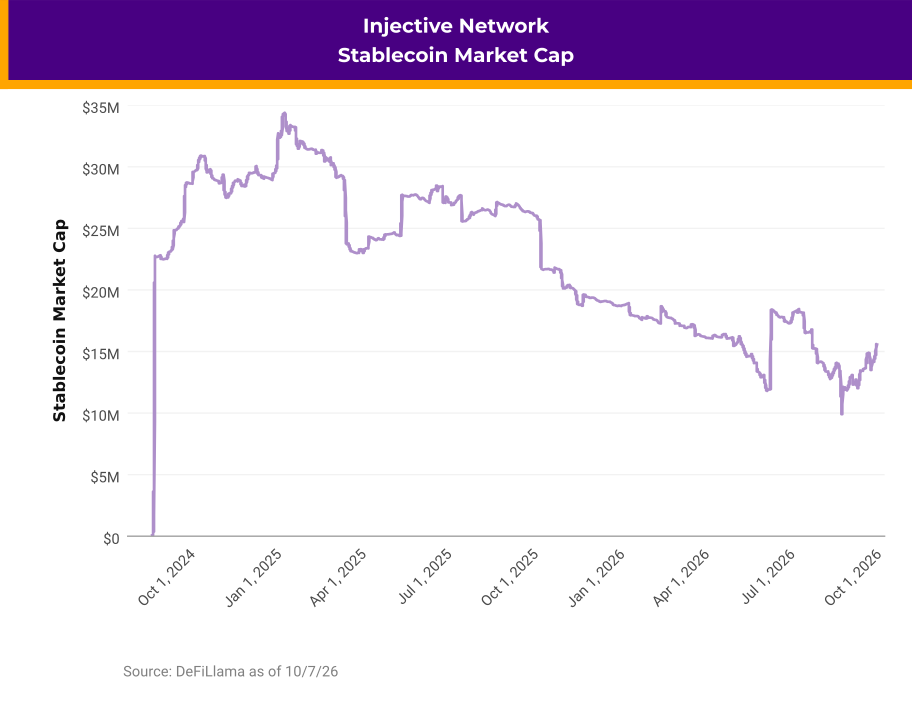
As of October 2026, DefiLlama reported approximately $18 million in DeFi TVL and $17 million in stablecoin market capitalization on Injective. Since September 10, Injective has served as the canonical USDC issuance network for Cosmos, while dYdX Chain plans to adopt USDC.inj as its sole eligible trading collateral.
Injective’s relatively small TVL represents both a current limitation and a potential growth opportunity. Unlike networks where economic activity is concentrated in lending protocols and automated market maker (AMM) pools, Injective emphasizes trading and financial applications. Its on-chain central limit order book (CLOB) facilitates order matching and liquidity provision by a decentralized network of professional firms and institutions, meaning capital can support trading activity without being deposited into traditional liquidity pools. Consequently, TVL may understate Injective’s economic activity, making trading volume, market liquidity, and financial application usage important complementary indicators of network adoption.
Source: DeFiLlama as of 10/7/26
Injective: Infrastructure for On-chain Finance
Injective has developed from a decentralized derivatives project into a specialized Layer-1 focused on financial markets. The network’s central thesis is that financial applications benefit from blockchain infrastructure specifically designed around trading, settlement, liquidity, interoperability and composability. Its native exchange module, orderbook infrastructure, oracle system, interoperability architecture and Multi–Virtual Machine (Multi-VM) capabilities differentiate Injective from more generalized Layer-1 networks.
For investors, the Injective thesis is closely tied to the continued expansion of on-chain financial markets, including decentralized trading, perpetuals, tokenized real-world assets, stablecoins and other programmable financial products. The token is also structurally linked to network activity through staking, governance, transaction fees and the Community BuyBack mechanism. The long-term opportunity for Injective therefore depends on whether specialized blockchain infrastructure can capture a growing share of financial activity moving on-chain.
How to get exposure?
For investors who want staked INJ without managing the asset directly, a single-asset ETF is the most direct route. INJC is built to do exactly that — one asset, one ticker, no wallet necessary. Investing involves risk, including a loss of principal.
Find out more about INJC at CanaryETFs.com/INJC
Risks & Disclosures
INJ is subject to unique and substantial risks, including significant price volatility and lack of liquidity and theft. INJ is subject to rapid price swings, including as a result of actions and statements by influencers and the media, changes in the supply of and demand for digital assets, and other factors. There is no guarantee that INJ will maintain its value over the long-term.
The statements, views, and opinions expressed herein are those of the Canary Capital Group LLC. The information presented is derived from sources the Firm believes to be reliable; however, the Firm makes no representation or warranty as to the accuracy, completeness, or timeliness of such information. The digital asset landscape is rapidly evolving, and information provided may change over time without notice.
*As of date: October 26, 2026
Glossary of Key Terms
Cosmo Ecosystem
An interconnected network of independent, application-specific blockchains designed to communicate and share value seamlessly.
Tendermint
A software for securely and consistently replicating an application on many machines.
CometBFT (historically known as Tendermint Core) is a Byzantine Fault Tolerant (BFT) State Machine Replication (SMR) engine that securely replicates deterministic application states across a distributed network of machines.
Decentralized Finance (Defi)
It refers to financial services built on blockchain networks that operate through smart contracts rather than relying entirely on traditional financial intermediaries, such as banks or brokers.
Ethereum Virtual Machine (EVM)
An environment that allows a blockchain to run smart contracts written for Ethereum. Think of it as a compatibility layer that lets developers bring Ethereum-based applications and tools to a blockchain built using different technology.
P/F Ratio – Price to Fee Ratio
Price-to-Fees Ratio in crypto and digital assets.It measures how much investors are paying for a crypto asset relative to the fees generated by its underlying blockchain or protocol.
P/S Ratio – Price-to-Sales Ratio
It measures how much investors are paying for a company’s stock relative to the company’s revenue.
Multi–Virtual Machine (Multi-VM)
An architecture that allows a blockchain to support multiple virtual-machine environments and development frameworks.
Stablecoin Market Capitalization (Stablecoin Mcap)
Refers to the total market value of all stablecoins in circulation, such as USDT (Tether) and USDC (USD Coin).
DEX (Decentralized Exchange)
A platform that lets people trade crypto directly through blockchain-based systems, typically using smart contracts rather than a centralized exchange like Coinbase.
Perps (Perpetual Futures)
Crypto derivatives that let traders speculate on whether an asset’s price will rise or fall without owning the underlying asset. Unlike traditional futures, perpetual contracts have no expiration date.
Blockchain
A distributed digital ledger that records transactions across a network of computers without requiring a centralized authority.
INJ
The native cryptocurrency of the Injective network. INJ is used for transaction fees, staking, governance, network security and participation in the Injective economy.
Proof-of-Stake (PoS)
A blockchain consensus mechanism in which validators secure the network by staking tokens.
Validator
A network participant responsible for validating transactions, producing blocks and maintaining consensus.
Staking
The process of locking or delegating INJ to participate in network security and earn staking rewards.
Governance
The process through which INJ holders participate in decisions affecting network parameters, upgrades and protocol development.
Orderbook
A market structure that records outstanding buy and sell orders and matches them according to predefined rules.
Decentralized Exchange (DEX)
A blockchain-based trading platform that allows users to trade assets without relying on a centralized intermediary to custody funds.
Perpetual Futures
A derivative contract that tracks the price of an underlying asset without a fixed expiration date.
Inter-Blockchain Communication (IBC)
A protocol that enables communication and asset transfers between compatible blockchains.
Community BuyBack
Injective’s monthly mechanism in which participants commit INJ in exchange for a pro-rata share of ecosystem revenue, while the committed INJ is permanently burned.
Slashing
A protocol-enforced penalty under which a proportion of the INJ staked with a validator is permanently forfeited following a penalized infraction. As of October 2026, the proportion forfeited on the Injective Network was set to zero for both double-signing and downtime. These parameters are set by INJ holder governance and may be changed.
Jailing
The removal of a validator from the active validator set following a penalized infraction. While jailed, neither the validator nor holders who have delegated to it earn staking rewards.
Unbonding Period
The waiting period that applies after staked INJ is undelegated, before it becomes transferable. On the Injective Network this period is 21 days, during which the INJ earns no staking rewards.
Goal Bonded Percentage
The share of total INJ supply the protocol targets as bonded to validators. Issuance rises when the actual bonded share is below the target and falls when it is above. The target was 60% as of October 2026.
Token Burn
The permanent removal of tokens from circulation by sending them to an inaccessible address.
Total Value Locked (TVL)
A metric measuring the value of assets deposited into decentralized applications and protocols.
Real-World Asset (RWA)
A traditional financial or physical asset represented or made accessible through blockchain-based infrastructure.
iAsset
Injective’s framework for programmable real-world assets designed to allow tokenized financial assets to interact with other on-chain financial applications.
Layer-1 Blockchain
A base-layer blockchain with its own consensus mechanism, security model and transaction-processing infrastructure.
MultiVM
An architecture that allows a blockchain to support multiple virtual-machine environments and development frameworks.
Finality
The point at which a blockchain transaction is considered confirmed and irreversible.