Network Overview
Solana is a high-performance Layer-1 blockchain designed for scalable decentralized applications, payments, and financial infrastructure. The network prioritizes low latency, high throughput, and low transaction costs, positioning itself as a blockchain optimized for consumer-scale applications rather than purely settlement-focused use cases.1,2
Solana’s architecture differs materially from most Layer-1 networks by emphasizing hardware efficiency and parallel transaction execution. Rather than relying heavily on Layer-2 scaling solutions like Ethereum, Solana attempts to scale directly on the base layer. The network combines Proof of Stake (PoS) with a cryptographic clock called Proof of History (PoH), enabling validators to process transactions in parallel and reduce coordination overhead.3
The result is a blockchain capable of handling thousands of real-world transactions per second with sub-second finality and transaction fees typically measured in fractions of a cent. This performance profile has made Solana a major hub for retail trading activity, memecoins, decentralized exchanges, NFT applications, payments, and increasingly institutional trading infrastructure.1,2
The ecosystem has grown rapidly since 2023, driven by applications such as decentralized exchanges, token launchpads, payments, and on-chain consumer apps. During periods of elevated market activity in 2025, the network processed over 200 million daily transactions and up to $39 billion in daily DEX volume without experiencing downtime.2
Founders, Goals and Network Architecture
Solana was founded in 2017 by Anatoly Yakovenko, a former Qualcomm engineer with expertise in distributed systems and compression algorithms. He was joined by Raj Gokal and a team of engineers with backgrounds at Qualcomm, Intel, and Dropbox. The founding vision was to build a blockchain capable of supporting internet-scale applications without sacrificing composability or relying heavily on external scaling layers.3 The core thesis behind Solana was that most blockchains were constrained not by bandwidth, but by inefficiencies in validator coordination and transaction ordering.
At the center of Solana’s architecture is Proof of History (PoH), a cryptographic timestamping mechanism that acts as a decentralized clock for the network.3 Rather than requiring validators to repeatedly communicate to determine the order of transactions, PoH establishes a verifiable chronological record of events before consensus takes place. By reducing the coordination required during consensus, PoH enables substantially higher throughput and lower latency than traditional blockchain architectures such as Bitcoin. Whereas Bitcoin’s base layer processes approximately 7 transactions per second with an average 10-minute block interval4, Solana routinely processes thousands of transactions per second and produces blocks approximately every 400 milliseconds, delivering roughly 300–600× greater practical throughput and more than 1,000× lower block latency5.
Solana’s architecture also includes several specialized performance optimizations:
| Component | Description | Purpose |
| Tower BFT | A Proof-of-Stake consensus mechanism built on top of Proof of History (PoH). | Enables fast finality and efficient network consensus. |
| Sealevel | A parallel smart contract runtime that executes non-overlapping transactions simultaneously. | Increases throughput by processing many transactions in parallel. |
| Turbine | A block propagation protocol designed to minimize bandwidth requirements. | Improves scalability and speeds up block distribution across validators. |
| Gulf Stream | A mempool-less transaction forwarding system. | Reduces confirmation latency and improves transaction execution efficiency. |
| Pipelining | Hardware-optimized transaction processing across validator stages. | Maximizes hardware utilization and accelerates transaction processing. |
| Cloudbreak | A horizontally scaled accounts database optimized for high read/write throughput. | Supports large-scale state management and high-performance data access. |
Together, these components create a vertically integrated architecture optimized for high throughput directly at the base layer, rather than relying on Layer-2 scaling solutions.
Solana Labs was the original developer behind the Solana blockchain and remains one of the ecosystem’s most important contributors. The organization designed the network’s core architecture, including Proof of History, Tower BFT, and the original validator client implementation. As the ecosystem matured, Solana Labs began decentralizing protocol development responsibilities in an effort to reduce operational concentration risk and foster a more distributed developer ecosystem.
This transition accelerated in 2024 with the formation of Anza, an independent Solana-focused research and engineering firm spun out from Solana Labs. Anza assumed responsibility for maintaining and advancing much of Solana’s core infrastructure while operating independently from both Solana Labs and the Solana Foundation. One of Anza’s primary responsibilities is maintaining Agave, the dominant production validator client currently used across the Solana network. Agave is effectively the successor to the original Solana Labs validator implementation and powers the majority of network validators today. The client is responsible for transaction execution, consensus participation, block propagation, and validator coordination.
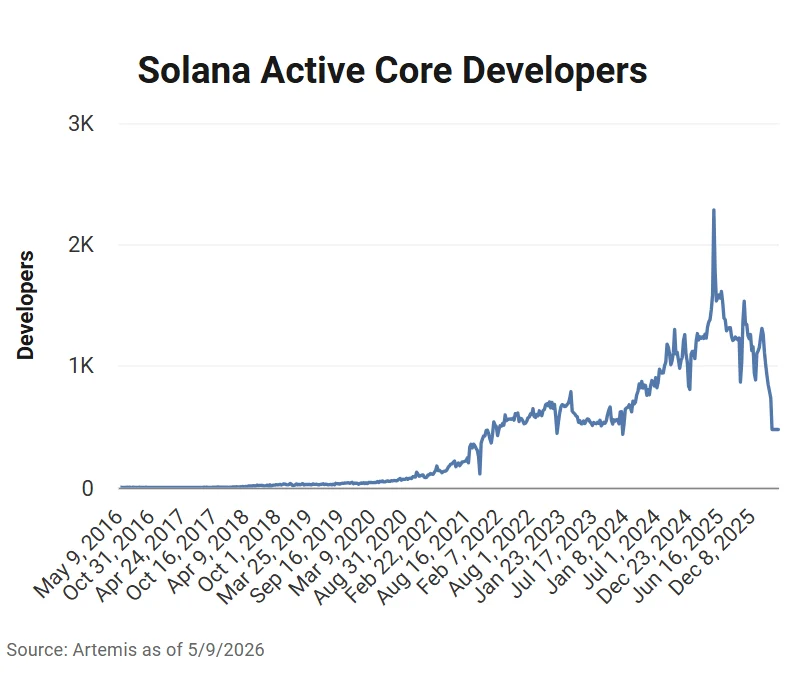
Solana is also transitioning toward a more diversified validator ecosystem. In addition to Agave, alternative validator clients such as Firedancer, developed by Jump Crypto, and Jito-Solana are helping reduce client concentration risk and improve overall network resiliency. Firedancer is particularly important because it represents a complete independent rewrite of the Solana validator stack in C/C++. The client aims to improve throughput, stability, and validator diversity, with testing environments reportedly achieving throughput exceeding 1 million transactions per second (TPS). Early mainnet deployment began in 2025, with broader validator adoption expected to continue through 2026.
Future Protocol Developments
Several major protocol upgrades are currently under development that could materially improve Solana’s performance, resiliency, and decentralization over the next several years.
Alpenglow
- Purpose: Proposed next-generation consensus architecture intended to reduce finality times and improve network responsiveness. Alpenglow may eventually replace portions of Tower BFT and reduce dependence on Proof of History coordination.
- Developer: Anza
- Target Improvements: Sub-second finality potentially approaching 100–150 milliseconds.
- Expected Timeline: Currently in research and testing stages, with potential phased implementation beginning in late 2026 or beyond.
Constellation
- Purpose: Multi-proposer architecture designed to improve censorship resistance, fairness, and transaction scheduling efficiency under heavy network load.
- Developer: Anza
- Target Improvements: Better block production coordination and reduced transaction bottlenecks during periods of elevated activity.
- Expected Timeline: Early-stage research initiative with no confirmed deployment schedule.
Validator Client Diversification
- Purpose: Reduce systemic risk from dependence on a single validator implementation.
- Developers: Anza, Jump Crypto, Jito Labs, and independent ecosystem contributors.
- Target Improvements: Increased network resiliency, decentralization, and fault tolerance.
- Expected Timeline: Ongoing throughout 2026–2027 as alternative clients mature and validator adoption increases.
Collectively, if implemented as planned, these upgrades represent a broader shift within the Solana ecosystem toward higher reliability, faster finality, and a more decentralized infrastructure stack capable of supporting institutional-scale financial and consumer applications.
Network Consensus
Solana’s consensus model combines Proof of Stake (PoS) with Proof of History (PoH). Validators stake SOL to participate in consensus and receive inflationary rewards plus transaction fees. Leaders are selected according to stake weight and produce blocks in scheduled time slots.
Source: https://solanabeach.io/validators as of 6/18/26
Historically, Solana’s most persistent criticism has been network reliability. Between 2021 and early 2024, the network experienced several high-profile outages and performance degradation events stemming from validator software bugs, spam attacks, excessive transaction load, and client coordination failures.
Critics argued that Solana’s pursuit of high throughput came at the expense of decentralization and resilience. Concerns centered on relatively demanding validator hardware requirements and the network’s reliance on a single dominant validator client, creating potential points of failure.
However, network reliability has improved since 2024. Following major infrastructure upgrades, the introduction of additional validator clients, and improvements to fee markets and spam mitigation, Solana has experienced a marked reduction in network disruptions. The network experienced numerous major outages between 2021 and early 2023, but has not suffered a comparable network-wide consensus outage since February 2024. According to the Solana Foundation’s 2025 Network Health Report, the network achieved approximately 16 consecutive months of uninterrupted uptime while processing record transaction volumes. This trend continued into 2026, with the network maintaining stable performance during periods of elevated activity and demonstrating greater operational resilience than in previous market cycles.
While reliability concerns have not been eliminated entirely, Solana’s outage profile has improved substantially, shifting the debate from whether the network can remain online to whether it can sustain long-term decentralization and performance at global scale.
| Network | Consensus | Recommended Validator / Node Hardware | Estimated Monthly Infrastructure Cost | Notes |
| Ethereum | PoS | 4–8 core CPU, 16–32GB RAM, 2TB NVMe SSD | $100–300 | Relatively lightweight validator requirements post-Merge; 32 ETH staking requirement for solo validator. (ChainScore Labs) |
| Solana | PoH + PoS | 12–24 core CPU, 128–256GB RAM, 2TB+ high-speed NVMe SSD, 1Gbps+ bandwidth | $500–1,500+ | One of the most hardware-intensive validator networks due to high throughput requirements. Voting fees also increase operational costs. (blockinfrahub.com) |
| Avalanche | PoS | 4–8 vCPU, 8–16GB RAM, 250GB–1TB SSD | $50–200 | Relatively accessible validator requirements compared to Solana and Aptos. (AI Native Finance Portal) |
| Sui | PoS | 12+ core CPU, 64–128GB RAM, 2TB NVMe SSD, 1Gbps internet | $300–800 | High-performance architecture creates elevated infrastructure requirements similar to Solana. (AI Native Finance Portal) |
| Aptos | PoS | 16–32 core CPU, 64GB+ RAM, 2–3TB NVMe SSD | $400–1,000 | Heavy hardware requirements designed for parallel execution architecture. (Domino Zone) |
| Polkadot | NPoS | 8 physical cores @ 3.4GHz, 32GB+ RAM, 2TB NVMe SSD | $200–500 | Strong single-threaded CPU performance emphasized for validator performance. (docs.polkadot.com) |
| Cosmos | Tendermint BFT | 4–8 core CPU, 16–32GB RAM, 500GB–1TB SSD | $50–250 | Cosmos Hub validators are comparatively lightweight and commonly run on cloud infrastructure. (ChainScore Labs) |
| Cardano | Ouroboros PoS | 4–8 core CPU, 16GB RAM, SSD storage | $50–200 | Lower hardware requirements than most high-throughput chains. |
| Near Protocol | Doomslug PoS | 8 core CPU, 48GB RAM, 3TB NVMe SSD | $250–600 | Sharding architecture increases storage and throughput requirements. (Domino Zone) |
| Algorand | Pure PoS | 4–8 core CPU, 8–16GB RAM, SSD storage | $50–150 | One of the lighter enterprise-grade validator setups among major Layer 1s. |
Firedancer represents a structural improvement because it introduces meaningful client diversity among validator software implementations. Previously, most validators relied on the same software stack, creating a single point of failure risk. Multiple independent validator clients reduce the probability that a software bug can halt the network globally. The network is also pursuing future upgrades such as Alpenglow, which aims to reduce finality times toward approximately 150 milliseconds.
Despite these improvements, Solana still faces ongoing debates around validator centralization, hardware costs, Maximal Extractable Value (MEV) dynamics, and transaction spam. Failed transaction rates during periods of high congestion remain a notable issue, particularly in speculative trading environments.
Token Supply
SOL is the native asset of the Solana network and serves several core functions:
- Payment of transaction and priority fees
- Validator staking and delegation
- Network security and economic alignment
- Governance and ecosystem participation
As of mid-2026, Solana’s circulating supply is approximately 580 million SOL, with a total supply of roughly 628 million SOL per CoinMarketCap. Unlike Bitcoin’s fixed supply model, Solana employs a disinflationary issuance schedule designed to balance network security with long-term monetary discipline.
Solana launched with an initial inflation rate of 8% per year. This rate declines by 15% annually until reaching a terminal inflation rate of 1.5%.2 After more than five years of operation, the network is now well into this disinflationary process, with current inflation estimated at approximately 4–5% annually, placing Solana closer to its long-term steady state than its early high-emission phase. As issuance continues to decline, network security is expected to become increasingly supported by transaction fees and application-driven economic activity rather than token inflation alone.
SOL’s supply distribution has historically been a point of contention, as a meaningful portion of the initial token supply was allocated to insiders, venture investors, and the Solana Foundation. This led to criticism that ownership was more concentrated than in some other blockchain networks.
Over time, however, token ownership and network participation have become substantially more distributed as the ecosystem has matured and institutional participation has increased. Today, SOL ranks among the world’s most actively traded digital assets by trading volume and has achieved broad institutional recognition, as evidenced by its inclusion in regulated investment products, adoption by leading financial institutions, and growing regulatory recognition across multiple jurisdictions.6
A substantial portion of the circulating supply is staked, making Solana one of the largest Proof-of-Stake networks by economic security. The validator set has also expanded significantly since launch and now includes thousands of independent validators operating across multiple jurisdictions. While concentration concerns remain a topic of debate, the network is substantially more distributed today than during its early years.
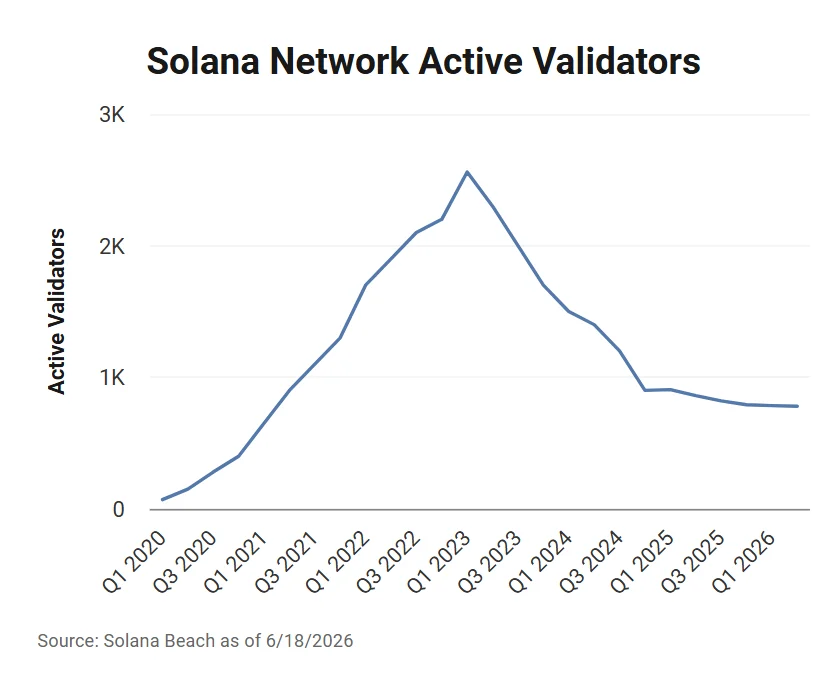
The evolution of validator economics is particularly noteworthy. In Solana’s early years, validator revenues were predominantly driven by inflationary staking rewards. Today, a growing share of network revenue originates from real economic activity, including:
- Decentralized exchange (DEX) trading
- Stablecoin settlement
- Consumer and social applications
- Memecoin trading activity
- MEV infrastructure and blockspace markets
- Decentralized Physical Infrastructure Networks (DePIN)
- Payments and financial applications
This transition reflects Solana’s progression from a network primarily subsidized by token issuance toward one increasingly supported by demand for blockspace. As application activity expands, validator economics become more closely tied to transaction fees, priority fees, and other forms of network usage, reducing reliance on inflation as the primary source of security incentives.2
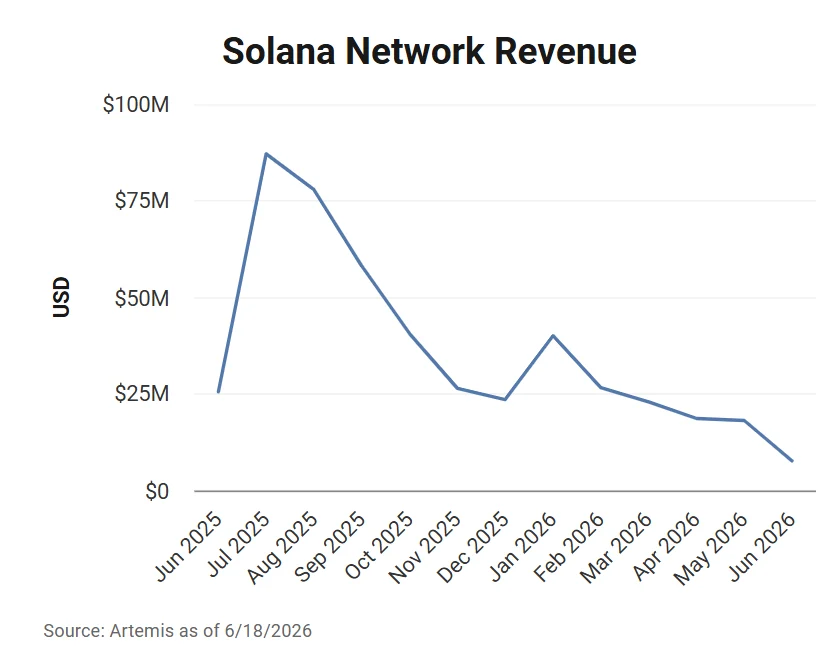
Economic activity on Solana increasingly comes from; decentralized exchange (DEX) trading, stablecoin settlement, consumer applications, memecoin speculation, MEV infrastructure, and Decentralized Physical Infrastructure Networks (DePIN) and payment applications. A growing share of validator economics is now tied to priority fees and application-driven revenue rather than pure inflation subsidies.
The Regulatory Landscape: Navigating the SEC
Solana’s relationship with regulators has been one of the most important overhangs on the asset since 2022. The network’s early growth was heavily associated with Sam Bankman-Fried (SBF), FTX, and Alameda Research, all of which promoted Solana as a high-performance alternative to Ethereum. FTX-affiliated entities invested heavily throughout the ecosystem, supported infrastructure development, and accumulated large SOL positions. While this accelerated ecosystem growth, it also created meaningful concentration risk. Following the collapse of FTX and Alameda in late 2022, markets became increasingly concerned about forced SOL liquidations, insider ownership concentration, and the long-term resilience of the ecosystem. The resulting selloff drove the SOL price to cycle lows and temporarily damaged institutional confidence in the network.
Recent regulatory developments have reduced some uncertainty; however, the regulatory treatment of digital assets remains subject to change. Regulatory pressure intensified in 2023 when the U.S. Securities and Exchange Commission (SEC), under Chair Gary Gensler, identified SOL as a potential unregistered security in lawsuits against Coinbase and Binance. The designation introduced significant uncertainty around exchange listings, institutional participation, and future product approvals. Several platforms, including Robinhood, temporarily delisted SOL in response. Despite these headwinds, Solana experienced a substantial recovery between late 2023 and early 2024, driven by renewed retail activity, memecoin trading, rising developer engagement, and growing confidence that the network could survive independently of the FTX ecosystem.
The regulatory environment began shifting materially in late 2024 and throughout 2025. Robinhood relisted SOL as policy expectations evolved, while the SEC under new Chair Paul Atkins softened its enforcement posture toward portions of the digital asset industry. The SEC later dismissed its case against Coinbase and paused proceedings against Binance, signaling a broader reassessment of crypto regulation in the United States. At the same time, policymakers increasingly focused on decentralization metrics and network functionality rather than solely on early fundraising structures when evaluating whether a blockchain asset should be treated as a security.
Commodity Status Distinction
Regulatory clarity around Solana has continued to improve following a broader 2026 SEC and CFTC interpretive framework that formalized a taxonomy of “digital commodities” and included SOL among assets classified under this category.7 This framework shifts regulatory analysis toward network functionality, decentralization characteristics, and economic utility, rather than primarily relying on token issuance history or fundraising structure. The result is a gradual movement toward treating assets like SOL more consistently with commodity-like regulatory principles, reducing uncertainty relative to earlier enforcement-driven classifications.
Network Activity
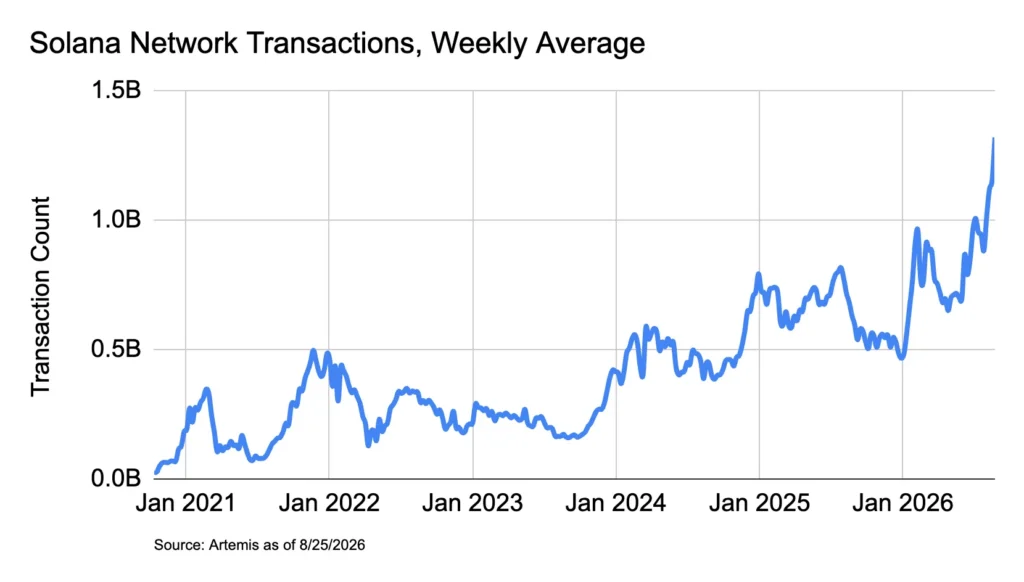
Solana has become one of the most active blockchain ecosystems by transaction count and retail participation based on data provided by Artemis.xyz on 8/25/26. The network’s low fees and high throughput have enabled applications that would be economically difficult on higher-cost chains.
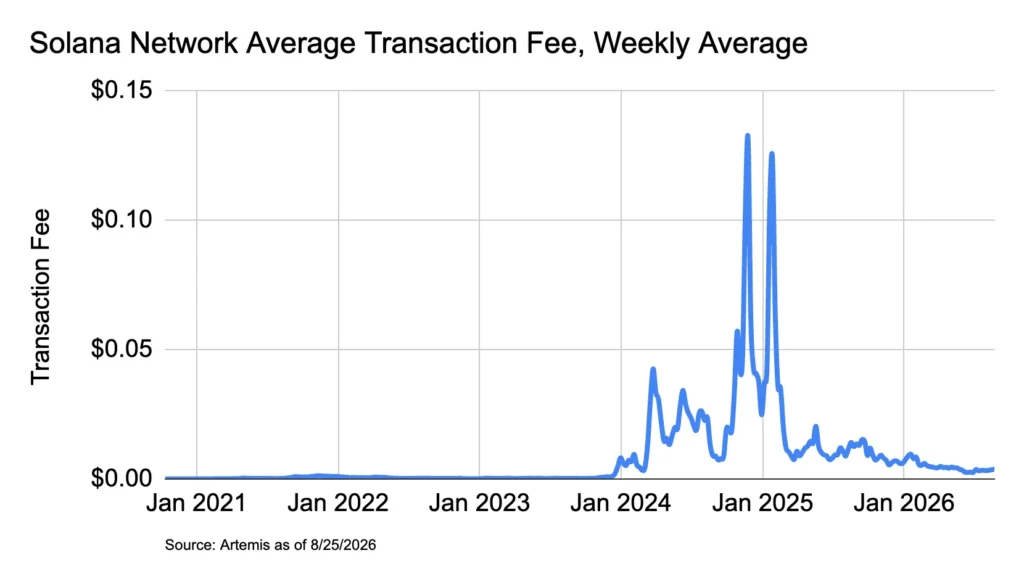
Market cap divided by fees is a valuation metric that can be understood as a crypto-native analog to the price-to-sales (P/S) ratio. This market cap should not be viewed as a predictor of future investment performance. In equities, P/S measures how much investors are paying for each dollar of a company’s revenue; here, market capitalization divided by annualized network fees shows how much the market is paying for each dollar of fee revenue generated by the Solana network. Like P/S, the multiple is driven primarily by expectations of future growth rather than current profitability. Elevated readings indicate that investors expect rapid increases in network activity, usage, or future monetization, while lower readings suggest either more modest growth expectations or that revenue is scaling faster than price.
As with early-stage or high-growth companies, this “network P/S” multiple should be interpreted with caution. Network fees are volatile, can be influenced by protocol parameters and subsidies, and do not represent revenue that directly accrues to token holders. As a result, the metric works best as a relative and directional tool rather than a valuation anchor. Compression in the ratio over time implies improving fundamentals as usage catches up to valuation, while expansion signals price appreciation running ahead of current fee generation. In practice, it is most informative when compared against the network’s own history or peer L1s and evaluated alongside adoption indicators such as transaction growth, active addresses, and fee growth rates.
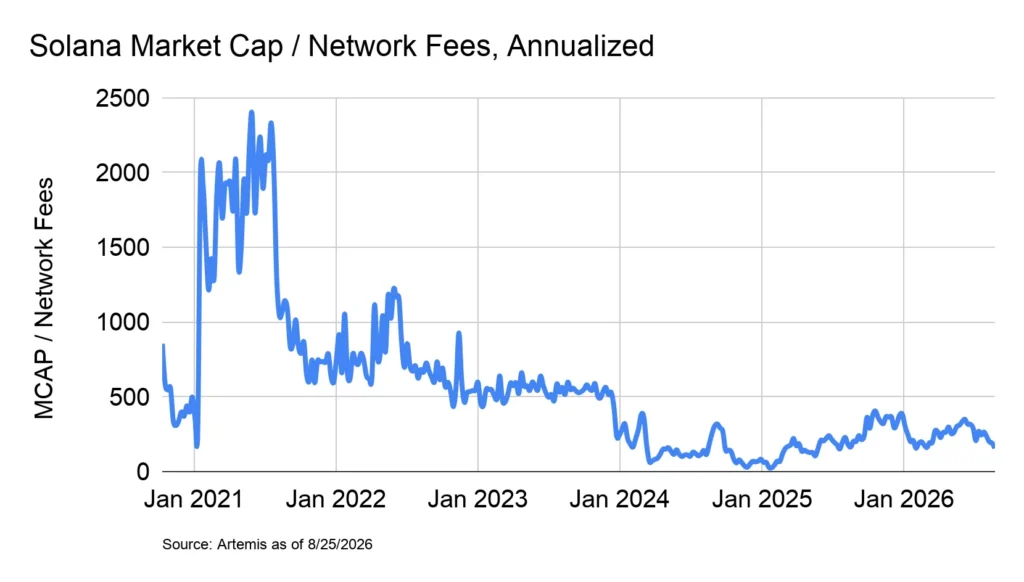
Active and unique addresses are key metrics for assessing a network’s fundamental value under Metcalfe’s Law, which holds that a network’s value is proportional to the square of its connected users (n²). Weekly active addresses (WAAs), which measure the number of unique wallet addresses that are active on a blockchain within a 7-day period, show
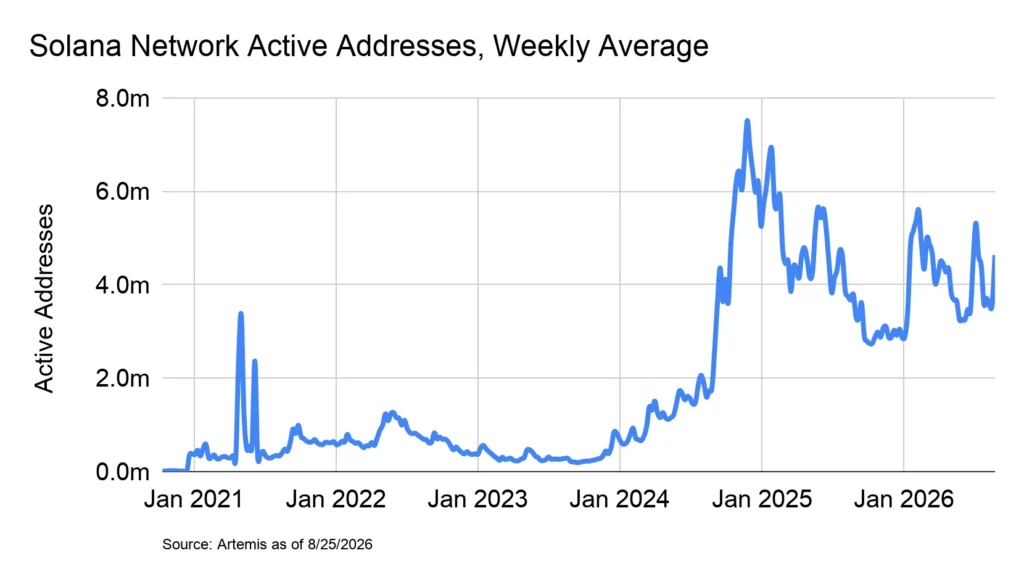
Total Value Locked (TVL) in Decentralized Finance (DeFi) is the total amount of cryptocurrency assets or USD deposited and “locked” in a protocol’s smart contracts, representing its size, liquidity, user trust, and overall health. Rising TVL suggests increased economic significance whereas falling TVL typically reflects a retrenchment in DeFi activity or a decline in underlying asset prices.
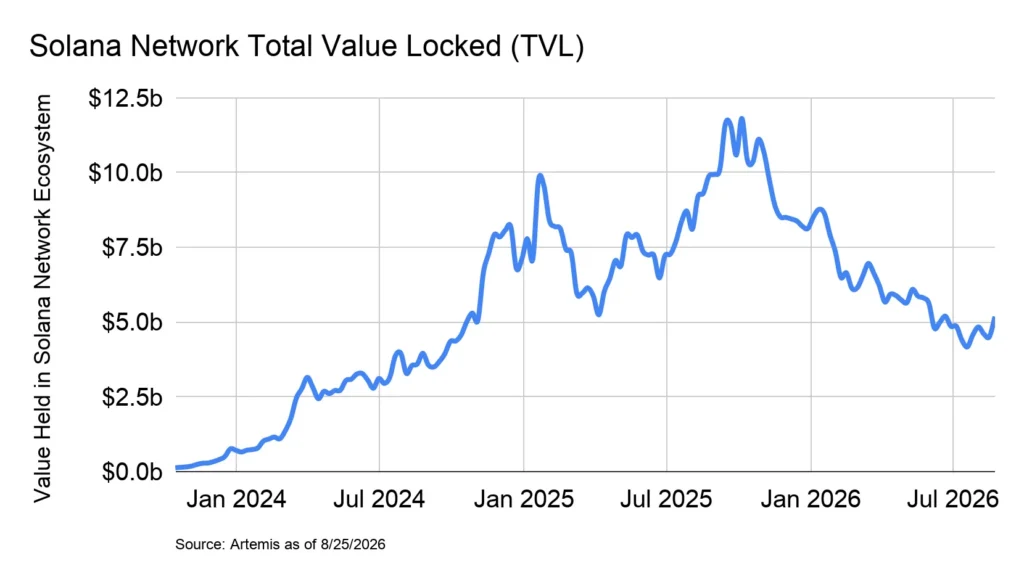
During periods of peak activity in 2025; Solana processed over 200 million daily transactions, DEX volume reached approximately $39 billion per day, and wallet downloads exceeded 400,000 in short bursts of activity.
Solana has also emerged as one of the dominant chains for retail speculative activity, particularly through token launchpads and memecoin ecosystems. Platforms like Pump.fun accounted for a substantial share of token issuance and DEX activity on the network.
At the same time, the ease of token creation has contributed to elevated fraud and rug-pull activity relative to more mature ecosystems. Research published in 2026 identified widespread short-duration scam token behavior across newly issued Solana Program Library (SPL) assets.
From a developer perspective, Solana continues to attract infrastructure investment and active ecosystem development. The validator stack is diversifying, transaction schedulers are improving, and network clients beyond Agave are gaining adoption. The ecosystem increasingly positions itself as one of the highest-performance general-purpose blockchain optimized for financial and consumer internet applications.
Conclusion
Solana represents one of the most ambitious attempts to build a high-throughput, monolithic blockchain capable of supporting mass-market applications directly on Layer 1.1,3
Its core strengths include:
- High throughput
- Extremely low fees
- Fast settlement
- Strong retail adoption
- Growing developer ecosystem
- Improving validator infrastructure
These strengths are subject to the material risks identified in the risks section below, and that past network performance does not guarantee future results.
The network has evolved significantly from its early reputation for instability. Reliability improvements, validator client diversification through Firedancer, and increasing ecosystem maturity have strengthened the investment case for SOL as a major Layer-1 asset.
However, risks remain:
- Validator centralization concerns
- Core structural risk to decentralization, censorship resistance, and long-term institutional valuation ceiling.
- Speculative activity dependence (DEX/memecoins)
- Cyclical demand risk; heavy reliance on reflexive trading can weaken fee revenue durability in risk-off regimes.
- Competition from Ethereum rollups + new L1s
- Long-duration market share and liquidity gravity risk, especially if rollups close UX/performance gaps.
- Transaction spam / network load
- Primarily an execution and UX degradation issue; increasingly managed through fee markets and engineering mitigations.
Ultimately, Solana’s long-term prospects will depend, among other factors, on whether its technology and network capabilities lead to sustained use and economic activity beyond speculative trading.
How to get exposure?
Investors seeking exposure to Solana may consider a variety of investment vehicles, including exchange-traded products. SOLC seeks to provide exposure to Solana through a registered ETF structure.
Find out more about SOLC at CanaryETFs.com/SOLC
Risks & Disclosures
Solana is subject to unique and substantial risks, including significant price volatility and lack of liquidity and theft. Solana is subject to rapid price swings, including as a result of actions and statements by influencers and the media, changes in the supply of and demand for digital assets, and other factors. There is no guarantee that Solana will maintain its value over the long-term.
The statements, views, and opinions expressed herein are those of the Canary Capital Group LLC. The information presented is derived from sources the Firm believes to be reliable; however, the Firm makes no representation or warranty as to the accuracy, completeness, or timeliness of such information. The digital asset landscape is rapidly evolving, and information provided may change over time without notice.
Sources
- Solana Official Documentation (https://solana.com/docs)
- Messari – Solana Research
- Anatoly Yakovenko – Proof of History Whitepaper (2018)
- Bitcoin Blockchain Explorer (https://mempool.space)
- Solana Blockchain Explorer (https://explorer.solana.com)
- Overview of Institutional Real World Assets on Solana (https://solana.com/tr/news/overview-of-institutional-real-world-assets-on-solana)
- Application of the Federal Securities Laws to Certain Types of Crypto Assets and Certain Transactions Involving Crypto Assets
(https://www.sec.gov/rules-regulations/2026/03/s7-2026-09)
- https://www.artemis.ai/company/SOL (8/25/26)
Glossary
DeFi (Decentralized Finance)
A blockchain-based financial system that removes intermediaries by using smart contracts to enable lending, trading, and other financial services.
L1 Blockchain (Layer 1 Blockchain)
The base blockchain network responsible for security, consensus, and transaction settlement (e.g., Bitcoin, Ethereum).
Proof of History (PoH)
A cryptographic clock that timestamps transactions before consensus, allowing validators to agree on ordering without constant communication, improving throughput and efficiency.
Proof of Stake (PoS)
A consensus mechanism where validators stake SOL to participate in block production and validation, earning rewards proportional to their stake.
Validator
A node in the Solana network responsible for processing transactions, maintaining consensus, and producing blocks in exchange for staking rewards and fees.
Tower Byzantine Fault Tolerance (BFT)
Solana’s Proof-of-Stake consensus algorithm built on top of Proof of History, enabling fast finality by locking in voting decisions over time.
MEV (Maximal Extractable Value)
The profit validators or searchers can extract by reordering, including, or excluding transactions within a block.
DEX (Decentralized Exchange)
On-chain platforms where users trade crypto assets directly via smart contracts without centralized intermediaries.
Finality
The point at which a transaction is considered irreversible and permanently confirmed by the network consensus.